




Blog
Testosterone: 3 Weeks to Libido, 6 Months to 1kg for Men, With Tests


Libido and mood are usually the first things to shift, often within three weeks of starting testosterone therapy. Visible muscle gain and fat loss take far longer, typically 12 to 16 weeks to become measurable and up to a year to peak. The dramatic transformation photos circulating online almost always combine testosterone with disciplined training and diet, not testosterone alone.
TL;DR:
- Testosterone’s effects on libido and mood typically appear within three weeks, while physical changes like muscle gain may take six months or longer.
- Visual transformation photos are unreliable indicators of progress because lighting, posture, and water retention can create misleading impressions.
- Accurate assessment relies on blood tests, body composition scans, and performance data taken at baseline and scheduled intervals, not just photos.
- Long-term benefits like bone density and hematocrit increases can take months to years, requiring consistent monitoring and ongoing medical oversight.
- Many men experience psychological improvements early, but true physical changes depend heavily on training, diet, and documented lab evidence.
Table of Contents
- Testosterone before and after: the realistic timeline of effects
- How to read before-and-after photos without being misled
- Measuring real testosterone before and after results
- Risks, trade-offs and monitoring every man should know
- Three case timelines that map feelings to numbers
- Publisher perspective: how we verify before-and-after evidence
- Psychological and cognitive changes before and after therapy
- Preparing to start testosterone therapy: pre-treatment evaluations
- Long-term maintenance and what happens if you stop
- Cardiovascular health and metabolic parameters
- What the evidence actually tells us
- A documented way to track your own testosterone progress
- Sources
Testosterone before and after: the realistic timeline of effects
Most men researching testosterone before and after results want one thing: a straight answer on when things change. The honest answer is that different systems in the body respond on completely different clocks, and expecting muscle gain at the same speed as a libido lift is where most disappointment comes from.
Sexual interest tends to move first. Clinical reviews tracking the onset of testosterone effects show libido improving within about three weeks of starting treatment, with a plateau reached around six weeks. Mood follows a similar early trajectory, with noticeable lift from roughly three weeks, though depressive symptoms can keep improving for a much longer stretch, sometimes not maxing out until somewhere between 18 and 30 weeks into therapy.
Energy sits somewhere in the middle. Men often describe feeling less foggy and less prone to afternoon crashes within the first month, but this is subjective and hard to separate from the psychological boost of simply doing something about a problem that has been dragging on for months or years.
Body composition is the slow mover. Lean mass increases and fat mass reductions typically only become detectable at 12 to 16 weeks, and the same research pins peak improvements between six and twelve months. That gap between “I feel different” at week three and “I look different” at month four is exactly where most men lose patience, or worse, start blaming the therapy for not working.
Here’s the detail that trips people up: weight and BMI often barely move even when real recomposition is happening. Muscle is denser than fat, so a man can lose several kilograms of fat and gain a similar amount of lean tissue while the bathroom scale reports no change at all. This is why tracking body composition, not body weight, matters far more than most men realise going into therapy.
Bone density sits at the far end of the timeline. Meaningful improvements here take six months at the earliest and often continue over years, which is one reason testosterone therapy is rarely a short-term intervention for men diagnosed with genuine hypogonadism.
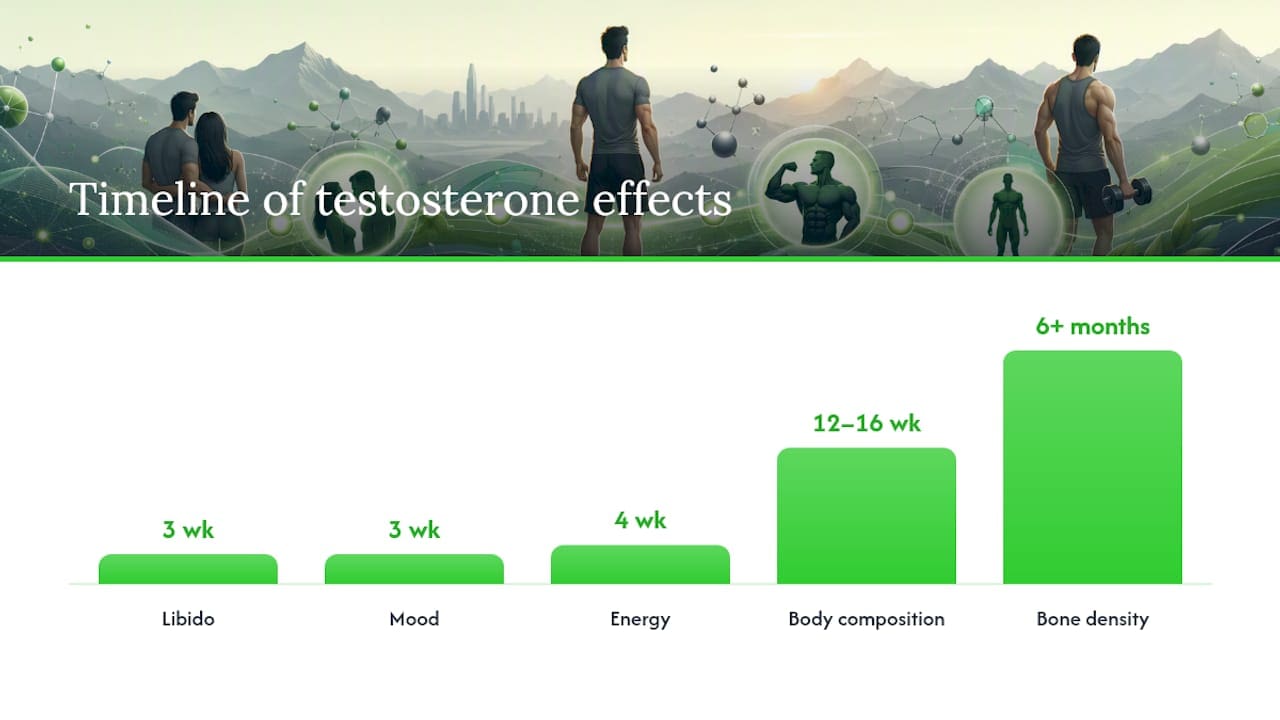
There is also erythropoiesis, the process of red blood cell production, which typically rises noticeably by around three months and can keep climbing towards nine to twelve months. This matters because it feeds directly into the safety monitoring covered later in this article.
A few things worth holding in mind as you read that table:
- “Noticeable” is a subjective threshold: it means a man reports feeling or seeing something, not that a lab test confirms it.
- “Clinically significant” is different again: it means the change is large enough and consistent enough to matter medically, which usually takes longer to establish than a personal impression.
- Individual variation is wide. Some men report libido changes within days; others take the full six weeks to notice the plateau.
- Concurrent factors, training intensity, sleep quality, calorie intake, all shift these windows earlier or later.
Understanding these separate clocks is the single biggest mindset shift for anyone starting therapy. The mistake is judging the whole treatment by the slowest-moving metric during the first month, when the fastest-moving ones are already delivering results.
How to read before-and-after photos without being misled
A transformation photo tells you almost nothing about testosterone on its own, because the camera cannot separate hormone effects from everything else happening in the frame.
Lighting alone can add or remove the appearance of muscle definition. A single overhead light source casts shadows that exaggerate ab separation and shoulder width; flat, diffuse lighting flattens the same physique into something far less impressive. Posture does similar work: a slight forward lean and flexed core in the “after” shot, next to a slouched, relaxed “before” shot, creates a visual gap that has nothing to do with hormones.
Then there’s the pump. Anyone who has trained knows that muscles look noticeably fuller for an hour or two after a workout, purely from blood volume, not from actual tissue growth. A photo taken straight after a gym session and compared to a rested, non-trained “before” shot is comparing two different physiological states, not two points on a testosterone journey.
Tan, tensing, and clothing choice round out the usual list of visual tricks. A tan creates shadow definition that pale skin under bright light simply cannot show. Deliberate tensing of the abdomen and lats can add the appearance of a leaner, more developed frame in seconds. Loose clothing in the “before” photo versus fitted or no clothing in the “after” photo does the rest.
Context matters just as much as camera angle. Meta-analyses of testosterone’s effect on body composition consistently show that the hormone nudges lean mass and fat mass in a favourable direction, but the magnitude of change reported in most trials is modest compared to what online transformation photos suggest. The men producing the most dramatic before-and-afters are almost always training with intent and eating with a plan alongside their treatment. Water retention, dehydration ahead of a photo shoot, and the timing of the last meal all add further noise that has nothing to do with testosterone at all.
Pro Tip: Before trusting any transformation photo, check whether the person discloses their training and diet approach alongside the hormone timeline. If they only mention the supplement or therapy, treat the image as marketing, not evidence.
A quick six-point checklist before you take any photo seriously:
- Same lighting, same angle, same time of day in both shots.
- No post-workout pump in either photo.
- Consistent posture and tension level.
- Disclosed training and nutrition approach alongside the hormone protocol.
- A stated timeframe, not a vague “after using this for a while.”
- Some objective number attached, whether that’s a blood test result, a scale weight, or a lift number.
Measuring real testosterone before and after results
Photos are the least reliable data point available to you. Blood tests, standardised body-composition scans, and logged performance numbers are what actually separate a real transformation from a lucky angle.

Start with a baseline blood panel before you change anything. The essentials are total and free testosterone, sex hormone-binding globulin (SHBG), estradiol, haematocrit, and prostate-specific antigen (PSA) for men over 40 or with risk factors. Clinical guidance on testosterone monitoring is clear that morning blood draws are essential, since testosterone follows a daily rhythm and afternoon results can understate true levels significantly.
A practical testing schedule looks like this:
- Baseline test, ideally two morning readings a week or two apart, to confirm a genuine deficiency rather than a one-off low reading.
- 6 to 12 weeks in, repeat total and free testosterone plus estradiol to check the dose is landing in a therapeutic range.
- 3 months in, add haematocrit and PSA to the panel, since erythropoiesis is typically well underway by this point.
- Every 6 to 12 months thereafter, following your clinician’s guidance, once levels and symptoms have stabilised.
Body-composition tracking deserves its own plan. DEXA scans are the most reliable method available outside a research lab, separating lean mass, fat mass, and bone density with strong repeatability. Bioelectrical impedance devices, the kind found in many gym-grade scales, are cheaper and more convenient but noticeably less consistent, particularly around hydration status on the day of the test. Simple tape-measure tracking of waist circumference, taken at the same time of day under the same conditions, is a reasonable low-cost alternative when a scan isn’t practical.
One number worth remembering: research on testosterone’s effect on lean mass finds average gains of roughly a kilogram of lean tissue within the first six months across pooled trial data. That is a group average, not a promise, and individual results vary a great deal depending on training, diet, and starting point.
Performance metrics round out the picture and cost nothing extra. Logging a five-rep max on a squat or bench press once a month gives you a number that moves in a fairly predictable relationship with genuine strength gain, unlike a photo or even a bathroom scale reading. Combined with quarterly blood work and a body-composition check every three to six months, this three-pronged approach, labs, scans, and lift numbers, gives a far more honest before-and-after story than any gallery of gym mirror shots. Naturaltestoman’s testosterone test kits are built around exactly this principle: verify the number, not just the mirror.
Risks, trade-offs and monitoring every man should know
Testosterone therapy is not risk-free, and the honest before-and-after story includes the trade-offs alongside the benefits.
Fertility suppression is the one most men underestimate. Exogenous testosterone signals the brain to reduce its own hormone production, which in turn lowers sperm production, sometimes significantly. Men who want to preserve fertility, particularly those not yet finished building a family, should discuss sperm banking or alternative protocols with a clinician before starting, not after.
Haematocrit rise is the trade-off most closely tied to the timeline discussed earlier. Research on erythropoiesis during testosterone treatment shows this typically becomes measurable by three months and can keep climbing towards nine to twelve months. Elevated haematocrit thickens the blood and raises clotting risk, which is exactly why the testing schedule above includes a check at the three-month mark rather than waiting a full year.
The risk profile changes sharply depending on the product. Prescription TRT is administered under medical supervision with regular blood work built into the process. Over-the-counter “testosterone boosters” are a different category entirely, and not always a safer one. A case report and review of testosterone booster supplements documents liver enzyme elevation and abdominal pain linked to repeated use of a commercial product, a reminder that “natural” and “risk-free” are not the same claim. This is precisely why ingredient transparency and dose documentation matter more in this category than almost any other supplement aisle.
A short list of red flags that warrant urgent medical review rather than waiting for the next scheduled test:
- Sudden vision changes, chest pain or shortness of breath.
- Unexplained swelling in the legs.
- Yellowing of the skin or eyes, or persistent abdominal pain.
- Testicular shrinkage accompanied by pain.
- Severe mood changes, including new aggression or depressive symptoms.
None of this is a reason to avoid therapy or supplementation outright. It is a reason to treat monitoring as part of the process rather than an optional extra bolted on afterwards.
Three case timelines that map feelings to numbers
Real testosterone before and after results rarely follow the same script. Three composite patterns cover most of what men actually experience.
Case A: the early responder. Libido and mood shift noticeably within the first three to four weeks, exactly matching the fastest-moving domain in the clinical timeline. Blood work at the six-week mark confirms a measurable rise in total testosterone, giving this man objective proof behind what he already felt subjectively. This is the pattern most likely to produce early confidence, and also the pattern most likely to create false expectations about how fast body composition will follow.
Case B: the disciplined recomposer. This is the pattern behind most genuinely impressive transformation photos. A man combines testosterone therapy with structured resistance training and a tracked diet, and by six months a DEXA scan shows a real lean mass increase alongside fat loss, matching the modest but consistent gains reported in pooled trial data. The visual change here is real, but it took six months and two other major lifestyle inputs working alongside the hormone, not testosterone acting alone.
Case C: the subjective winner without the dramatic photo. Energy, mood, and libido all improve meaningfully, but the mirror shows little change because training and diet stayed roughly the same as before treatment. This is arguably the most common real-world outcome, and it’s frequently misread as “the treatment isn’t working,” even though blood work confirms testosterone levels have normalised. A widely covered case of a man documenting his testosterone therapy captures this pattern well: genuine quality-of-life improvements without the physique overhaul that photos alone would suggest.
The common thread across all three cases is that the number on a blood test explains what the mirror cannot.
Publisher perspective: how we verify before-and-after evidence
ProofTesto was built around a simple frustration: the supplement industry is full of transformation photos and almost empty of testosterone tests. The product pairs documented ingredients with included testosterone tests specifically so that a before-and-after claim means something more than a flattering angle.
Every before-and-after example referenced on this site follows the same rule: it needs an objective metric attached, a blood test result, a scan, or a logged performance number, and it needs disclosure of any concurrent training or diet changes. A photo with no numbers behind it doesn’t meet that bar, regardless of how dramatic it looks.
This standard exists because the research is consistent on one point: testosterone nudges the body in a favourable direction, but the size of that nudge depends heavily on what else the person is doing. Clinicians managing plateaued cases typically look at hormonal labs and symptom patterns together rather than relying on visual progress alone, and that’s the same principle Naturaltestoman applies to its own product claims.
There is more validation work ahead, further customer case studies with paired blood work, and continued transparency on ingredient dosing, but the underlying commitment doesn’t change: measurable evidence first, glossy imagery second.
Psychological and cognitive changes before and after therapy
Mood and cognitive shifts tend to arrive earlier than most men expect, and they’re often what convinces a sceptical man that something real is happening before any physical change shows up.
Mental clarity and reduced brain fog are commonly reported within the first few weeks, alongside the mood improvements already covered in the timeline section. Confidence often rises in step with libido, partly hormonal and partly the psychological effect of finally addressing a problem that had been quietly eroding motivation for months.
Irritability and low-grade anxiety, both common symptoms of low testosterone, frequently ease over the same early window. Some men describe this as feeling “even” again, a return to a baseline temperament they had forgotten was normal.
Sleep quality often improves as testosterone normalises, which then compounds into better mood and sharper focus during the day, a knock-on effect that’s easy to miss if you’re only looking for muscle gain. Motivation to train and stick with a diet plan tends to follow the same curve, which is part of why disciplined recomposition, Case B from the section above, becomes more achievable once therapy is underway rather than before it starts.
Not every psychological shift is positive for every man. A small number report increased irritability or restlessness, particularly if a dose is too high or estradiol rises unchecked, which loops back to why regular blood work matters more than mood alone.
Preparing to start testosterone therapy: pre-treatment evaluations
Two separate morning blood tests confirming genuinely low testosterone, not one, are the standard starting point before any clinician should prescribe treatment. A single low reading can reflect illness, poor sleep, or simple lab variation rather than a persistent deficiency.
A full pre-treatment evaluation typically includes total and free testosterone, LH and FSH to assess whether the issue originates in the testes or the pituitary, prolactin, haematocrit, PSA, and a lipid panel. Symptom questionnaires help clinicians separate genuine hypogonadism from overlapping issues like sleep apnoea, depression, or thyroid dysfunction, all of which can mimic low testosterone symptoms convincingly.
Men planning a family should raise fertility preservation at this exact stage, before the first dose, since starting therapy without that conversation forecloses some options. A prostate exam and PSA baseline matter for older men or anyone with a family history of prostate issues, since PSA needs a pre-treatment reference point to interpret later changes meaningfully.
It’s also worth addressing foundational factors before assuming prescription therapy is the only route. Sleep quality, vitamin D status, and general metabolic health all influence natural testosterone production, and correcting deficiencies here sometimes closes part of the gap on its own. Naturaltestoman’s vitamin D supplement supports this foundational layer for men whose levels run low, a factor worth checking before assuming the only path forward is prescription treatment.

Long-term maintenance and what happens if you stop
Testosterone therapy is typically a long-term or indefinite commitment for men with diagnosed hypogonadism, and that fact deserves more attention before starting than it usually gets.
Bone density gains, the slowest-moving benefit in the entire timeline, continue building over years of consistent treatment. Stopping therapy doesn’t just pause that progress, it can reverse it, since bone remodelling responds to the hormonal environment currently present in the body, not the one from months earlier.
Libido, mood, and energy improvements tend to fade within weeks of discontinuation as testosterone levels drift back towards pre-treatment baselines. Men who stop therapy abruptly sometimes describe this as feeling worse than before they started, partly because the body has adjusted to the higher level and the drop feels more pronounced by comparison.
Muscle and fat composition changes are more durable if training habits built during therapy continue afterwards, but the hormonal contribution itself fades. This is the clearest illustration of why Case B from earlier, the disciplined recomposer, tends to hold onto results longer than Case A, the early responder who never changed training or diet.
Maintenance monitoring doesn’t stop once levels stabilise. Annual haematocrit and PSA checks remain standard for long-term users, and any dose adjustment should be followed by a fresh round of testing rather than assumed to be safe based on how a man feels.
Cardiovascular health and metabolic parameters
The cardiovascular question is the one that generates the most conflicting headlines, and the honest position is that the picture is nuanced rather than simple.
Metabolic markers often improve alongside testosterone normalisation. Insulin sensitivity, waist circumference, and lean-to-fat ratio tend to move in a favourable direction over the same 12-week to 12-month window covered in the body-composition timeline, particularly in men who were significantly deficient before starting.
The haematocrit rise discussed in the safety section is the primary cardiovascular caution point, since thicker blood increases clotting risk if left unmonitored. This is precisely why the three-month haematocrit check sits in the testing schedule rather than being left until an annual review.
Blood pressure occasionally rises during treatment, partly linked to increased red blood cell mass and fluid retention, which is another reason regular check-ins matter more than a one-off baseline reading. Cholesterol markers show mixed results across studies, with some men seeing modest LDL improvements and others seeing little change, underlining that individual metabolic response varies as much here as it does with muscle gain.
None of this replaces a conversation with a clinician about personal cardiovascular risk factors, family history, and existing conditions before or during therapy. The data supports monitoring as the sensible middle ground between blanket reassurance and unwarranted alarm.
What the evidence actually tells us
The conventional testosterone-before-and-after story sells patience short. Most content built around this topic either promises dramatic change fast or buries the real timelines under vague reassurance, and both approaches leave men either disappointed at week six or confused about why their photos don’t match someone else’s.
What the evidence actually supports is less exciting but more useful: libido and mood respond early, body composition takes months, and none of it means much without a number attached. The men who report the best long-term satisfaction with therapy are the ones who tracked labs alongside symptoms, not the ones chasing a mirror.
The biggest gap between advice and practice is verification. Nearly every guide tells men to expect changes; almost none tells them how to prove those changes happened. That’s the piece worth prioritising first, before dose, before brand, before photos: get a baseline test, then get another one on a schedule, and let the numbers, not the lighting, decide whether something is working.
— Magnus
A documented way to track your own testosterone progress
Most testosterone booster reviews online are built entirely on before-and-after photos with no lab work behind them. Naturaltestoman takes a different approach: the ProofTesto 30-Day Package pairs a natural testosterone formula with two included testosterone tests, so you’re measuring your own baseline and your own progress rather than trusting someone else’s transformation gallery.

The package includes a 30-day supply of ProofTesto alongside two home testosterone tests, one to establish where you’re starting from, one to check whether the formula is actually moving the number for you specifically. It’s worth being clear about what this is and isn’t: ProofTesto supports natural testosterone optimisation using ingredients with documented effect, and it is not a substitute for prescription TRT. Men with diagnosed hypogonadism or persistently low blood work should speak with a clinician about medical treatment options alongside any supplement strategy.
If you’re already testing regularly, the 30-day supply without tests covers a repeat order. Either way, the next step is straightforward: order the package, test your baseline, and let the follow-up result tell you what’s actually changed.
Sources
- Onset of effects of testosterone treatment and time span until maximum effects are achieved (Journal review)
- Before and after: 42-year-old man on testosterone therapy (Business Insider)